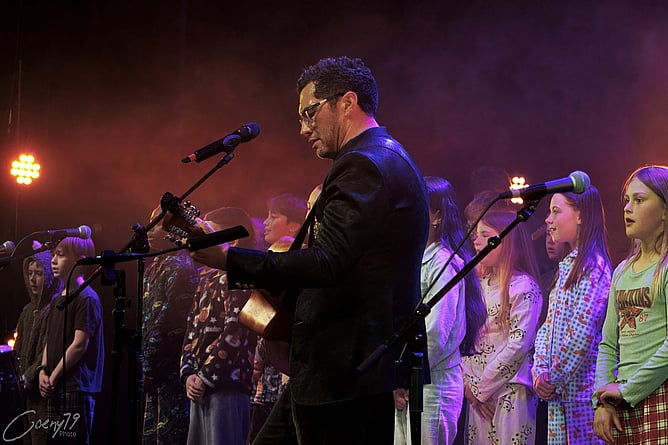
Jason Kerrison Has Performed on Some of Aotearoa’s Biggest Stages — So What Drew Him to Amplify Aotearoa?
What first drew you to Amplify Aotearoa?
Because I've been that kid. Most Sundays growing up, Dad was playing drums in the country music shows in Invercargill, and I'd be there with a bag of chips and a Coke, watching. Seven, eight, nine years old. I had no plan to do it myself. It wasn't ambition, it was just Sunday. But you absorb it. The way musicians count each other in. The looks across a stage when something's going off the rails. The way a room feels when a band locks in. All of that went in by osmosis.
Then years later De Funk Express won RockQuest, and part of the prize was studio time. I was on bass, first time I'd ever been on a fancy multitrack, and that sealed it. We shot our first music video on 16mm at the old Christchurch Arts Centre. Suddenly the thing I'd been watching since I was seven was a thing I could actually do. It was a permission slip, facilitated by an understanding teacher, Sue Eason at Hillmorton High. My music theory was less than substandard. I didn't want to read and analyse harmony in the Brandenburg Concertos. I wanted to play bass in a band.
That's what Amplify is doing. Putting kids in the room. Lachie did it last year too, with rangatahi recording and performing alongside Mike Chunn and Neil Finn. The impact on those kids was massive. He's not running a one-off, he's building something special, creating a legacy. Do you think it's getting harder for young musicians to make a record?
Depends what you mean by "make a record." The recording part is the easiest it's ever been. Laptop, $200 interface, you're away. The hard part is everything around it.
When I was fourteen, we were recording on a four-track cassette recorder in the St Bedes hall. We only had access because we'd pinched a key. Kids now are worried about whether they posted enough this week, whether the algorithm picked them up, whether they've got a "brand." That stuff eats hours that used to go into actually learning your instrument and absorbing the dynamics of being in a band.
Now, here's the contradiction. The same tech that's eating their attention is also handing them the best music education in history. When I was at school we'd get an itinerant teacher in for thirty minutes once a fortnight (violin, in my case) and then they were gone. That was the tuition. Done. Now a kid can sit down and watch the likes of Rick Beato on YouTube for hours, days, weeks. The acceleration is unreal. The knowledge is there, sitting on the table, if you go looking for it.
So it's the greatest time in history to learn music, and it's the easiest time in history to never bother because you're distracted by trying to go viral with essentially the same online tool. Same device, same tool. The difference is whether you actually want to learn, or just want to be seen.Are you excited for the Hamilton concert?
I absolutely can't wait. Lachie's pulled together something genuinely special. Hollie Smith, Harry Lyon, Jesse O'Brien, Mike Chunn, Nathan King, Andrew McLennan, Emlyn Crowther, plus video sessions with Don McGlashan and the lads from The Exponents. Every one of those names could be doing something else with their time. They're not. That tells you something about the project.
I'm doing a song with around fifty Year 6s from Hamilton East School, and another set with a smaller band of rangatahi: Madi, Nicky, Sidney, Ziggy, Bowie and Georgez. The whole project's being pressed onto vinyl with cover art from Chris Knox, Dick Frizzell and Otis Frizzell, which is wild. That's the calibre of people Lachie's got behind this.
There's something different about playing a show where the whole point is the kids, not the headliner. Takes the ego out of it. You're there to hold space for them. I've always respected established musicians who make time to do that. It's a privileged position, and you should use it to kick the door open wide for them.
When I was a kid, Leif Garrett was filming Shaker Run in New Zealand and came down to our scout den. I'm not comparing myself to him, but that moment was a gift to all of us. Someone you'd only seen on a screen, standing in front of you, talking to you like you're a person too. It pulls the abstract into reality. The world you thought was somewhere else turns out to be right there. And the thing is, he didn't have to. Nobody made him. He just showed up.
That's what these shows do at their best. We all get to be real together by jamming on one stage. Music in common, music as the equaliser.What's the main thing you hope the kids get out of this?
That they're allowed, that they're welcomed in, encouraged. That's the whole thing for me.
So many kids talk themselves out of music before anyone else gets the chance to. They decide it's not for them and that's that. I was that kid. I'd watch my mates get up there in their fancy tassels and cowboy hats, playing guitar at the Sunday shows, and I never once thought that'll be me. I was super shy — even peed my pants standing up to talk in front of the class when I was five. The idea of doing it later in life didn't cross my mind. I was terrified of eyes on me.
Cut forward thirty-odd years and I've travelled the world, worked with incredible producers overseas. Most recently I was in Zurich at Powerplay Studios, the room where 'The Final Countdown' was recorded, cutting vocals for a Swiss band, Future Memories. That trip meant I got to take my family through Switzerland and France, take my little girl to Disneyland, and kneel on one knee at the Trocadéro with the Eiffel Tower right there in front of us, and propose to my wife. Music opened the door to every single one of those moments.
None of that was on the cards for the shy kid in the audience watching his mates. So when I say I hope these kids walk out feeling welcomed in, I mean it. If a few of them leave going "actually, I could do this," that's the win. The rest of it, the discipline, the collaboration, learning to handle a bad gig, that comes if they stick with it. But first they have to believe they're not just allowed in the room. They have to feel welcomed and valued.Are you hopeful for the future of music in Aotearoa?
Hopeful for the music? Yeah. Hopeful for the industry? That's where it gets complicated.
The question is two questions, really. First, are the established artists willing to turn around and pull the next lot through? Some are. Some just don't realise the value they could impart by doing so. Generally, everyone I've met has been pretty generous when it comes to helping rangatahi.
Second, are the people making the industry decisions - the radio broadcasters, the policy-makers, the executives - aware of the downstream impact of their calls? Some are. A lot aren't.
What disappoints me is how many young NZ artists are telling stories that aren't theirs. Lives they haven't lived, in places they've never been. Lorde was the antidote to that - Royals called it out directly. A teenager from Devonport pointing out we'd never seen a diamond in the flesh, and the world stopped to listen. That's what telling your own story can do. We need more of that. Encourage them to tell their own stories. Their own reflections of life here. And to do that, they need to actually hear themselves on the radio and in the productions around them.
That's the radio side of the problem. Almost every other country protects its domestic market. We've got a voluntary 20% target. Voluntary. Some commercial stations are sitting under 4%. Meanwhile Australia mandates 25% across the day, Canada requires 35%. The reason we can't make it mandatory is two trade agreements: CER with Australia, and GATS under the WTO.
Funny thing. The same year De Funk Express won RockQuest, a Labour MP named Graham Kelly was in Wellington trying to push a 20% music quota bill through parliament. And Kelly wasn't just some politician. He was a working musician himself, a piano player who led dance bands for years. Picture it: me at seventeen, walking into a multitrack room for the first time, and meanwhile a musician-MP fighting in Wellington to make sure kids like me could actually build a career off this. The bill died. Labour promised it again in '99, Helen Clark killed it in 2000 after the radio industry got in her ear. Mandatory local content is a commercial risk. Playing proven international hits is the safe bet. And these companies have shareholders to answer to - backing local talent is harder to justify on a balance sheet than rotating tracks that are already topping the global charts. Voluntary lets them off the hook.
The absurdity is, our own success stories prove it. Crowded House had to get Don't Dream It's Over to number two in the States before NZ radio would touch it. My hip hop/funk group The Babysitters Circus - towards the end of Opshop's time - had Everything's Gonna Be Alright hit number two in Holland before we got any radio support back home. Same pattern, same problem. Kiwi artists have to be validated overseas before our own stations will play us.
But here's the bigger structural problem hardly anybody's talking about. An entire generation has grown up subscribed to the whole history of recorded music for the price of a coffee a month. Or worse, the freemium model, free with ads. All at pennies to the artist. That's reshaped the economics of being a musician more than anything radio policy could touch. The kids coming through aren't just competing with each other. They're competing with the entire back catalogue of every band that's ever existed, all of it instantly streamable, all of it paying out fractions of a cent.
Sync is one of the real ways out of that. Getting your song placed in a film, a TV show, an ad, a game. That's where the actual money lives now for working writers, and most Kiwi artists don't know how to get into that tier. I've spent the last ten years putting together a book about it, NZ Music in Sync, pulling together my own experiences and the experiences of other Kiwi artists who've made it work. Basically writing the roadmap I wish I'd had when I started out. The hope is the next generation can step into that world quicker, with a map instead of having to draw their own.
So break the treaty on the radio side. Renegotiate it. Get more Kiwi music in Kiwi ears. But also wake up to where the money's actually flowing now and teach our young writers how to get into those rooms. We've got the talent. We've always had the talent. What we owe them is a system that lets them sound like themselves and make a living from it.
We should be exporting a diaspora of New Zealand music out into the world, not importing more music that has nothing to do with our authentic lived experience. That's what I support. That's what I tautoko.

